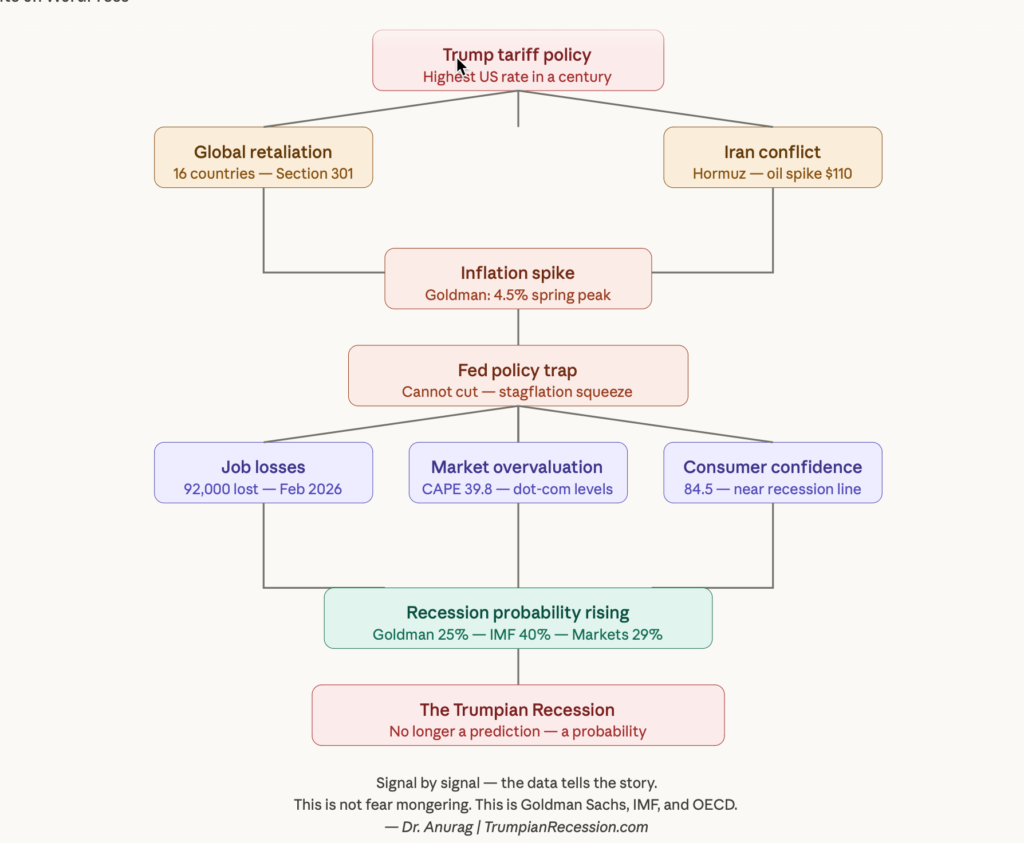
On March 13, 2026 — Goldman Sachs raised
its US recession probability to 25%. The
S&P 500 is at its most expensive valuation
since the dot-com crash of the year 2000.
February saw 92,000 jobs vanish. Oil is
heading toward $110 a barrel. And tariffs
are at their highest level in over a century.

History does not repeat. But it rhymes.
And right now — 2026 is rhyming loudly
with 1929.
Where The US Economy Stands Today — March 14, 2026
"Goldman Sachs raised US recession
probability to 25% on March 13 2026.
IMF puts it at 40%. February 2026 saw
92,000 jobs lost. S&P 500 is at its most
expensive valuation since the year 2000.
Brent crude heading toward $110 per barrel.
Consumer confidence at decade low of 84.5."
Factor
1929 Great Depression
2026 Trumpian Recession
Verdict
Tariff policy
Smoot-Hawley Act — triggered global retaliation
Trump tariffs — highest US rate in a century — 16 nations retaliating
Direct parallel
Stock market
Prices rose 6x in 8 years — economists called it permanently high — days before the crash
S&P 500 CAPE ratio 39.8 — most expensive since dot-com crash year 2000
Brent crude heading $110 — Strait of Hormuz 20 million barrels at risk
Inverse parallel
Global transmission
Gold standard forced all nations to raise rates — locked in depression together
Dollar dominance transmits US tariff pain to every trading economy simultaneously
Structural Parallel
7 Common Points between 1929 and 2026 :
- Tariff trigger — Both crises driven
  by aggressive US Republican tariff
  policy. 1929 Smoot-Hawley.
  2026 Trump tariffs.

- Overvalued markets — Stocks at
  extreme historical valuations.
  Economists called them justified
  just before collapse. Both times.

- Fed policy trap — Central bank
  unable to respond correctly.
  1929 raised rates. 2026 cannot
  cut due to stagflation.

- Labour market cracks — Job losses
  clearly visible before official crash.
  Warning signs dismissed both times.

- Presidential denial — Hoover said
  fundamentally sound. Trump says
  roaring. Same script. 97 years apart.

- Global transmission — US economic
  pain spread simultaneously to every
  major economy. 1929 via gold standard.
  2026 via dollar dominance.

- Key difference — 2026 has FDIC —
  SEC — Fed crisis playbooks — and
  unemployment insurance. But Goldman
  chief economist warns no playbook
  exists for tariff-induced recession.
RECESSION PROBABILITY
Institution
Recession Probability
GDP Forecast 2026
Key Concern
Goldman Sachs
25%
Slowing sharply
Jobs + oil + tariffs
IMF
40%
1.5% (was 2.8%)
Tariffs + trade war
OECD
Not stated
Below 3% globally
Global slowdown
JPMorgan
35 to 45%
1.4%
Policy uncertainty
Prediction Markets
29%
Not stated
Real money bets
SCENARIO PROBABILITY :
Scenario
Probability
Trigger
Impact
Soft landing
25%
Tariff resolution — Hormuz reopens quickly
GDP 1.5 to 2% — no official recession
Mild recession
45%
Tariffs persist — oil stays high — jobs keep falling
Full trade war — financial contagion — policy failure
1929 scale — generational damage
What to watch in the next 30 Days:
- Strait of Hormuz — resolution or
  escalation moves oil $20 either way

- March jobs report — losses above 50,000
  means Goldman odds cross 35%

- Fed March meeting — delayed cut signal
  means immediate market repricing

- Consumer confidence April reading —
  below 80 means recession confirmed

- S&P 500 correction beyond 10% —
  circuit breakers will be tested
Quote of the day :
“This is not a trade dispute. This is the dismantling of a global economic order built since 1945.”- — Dr. Anurag | TrumpianRecession.com
Disclaimer:
Disclaimer: This is economic research
and educational analysis only.
Not financial advice.
All data verified from Goldman Sachs —
IMF — OECD — Bureau of Labor Statistics
and Conference Board — March 2026.